

How Much Does Google Ads Cost?
Have you ever wondered why some online businesses scale overnight while others struggle to get noticed? The secret almost always lies in paid search marketing. But before jumping into the deep end, every business owner asks the same critical question: How much does Google Ads cost? The short answer is that you can spend as much or as little as you want because there is no mandatory minimum spend. However, understanding the real dynamics of a marketing budget requires looking beneath the surface. In this comprehensive guide, we will break down how the platform prices its ads, realistic industry benchmarks, hidden fees, and actionable strategies to make every single penny count.
Understanding the Mechanics: How Does Google Ads Pricing Work?
To understand how much Google Ads cost, you first need to understand its core engine: the ad auction. Google doesn’t just sell ad space to the highest bidder. Instead, it uses a dynamic, real-time auction system every time a user types a query into the search bar.
When a user clicks on an ad, the advertiser pays a specific fee. This structure relies heavily on a few primary pricing metrics:
- Cost Per Click (CPC): The amount you pay when a user physically clicks on your ad.
- Cost Per Mille (CPM): The amount you pay per 1,000 impressions (views), commonly used for visual brand awareness campaigns.
- Cost Per Acquisition (CPA): The total cost incurred to gain a single converting customer.
The Role of Maximum Bidding
When setting up campaigns, you define a Maximum CPC, which is the absolute highest amount you are willing to pay for a single interaction. However, thanks to the automated auction design, your actual cost-per-click is often lower than your maximum bid. You only pay the bare minimum required to outrank the advertiser immediately below you.
Average Cost Benchmarks: What to Budget Across Industries
Because costs are tied directly to active competition, the pricing varies wildly depending on what you sell and who you are targeting. Niche markets with smaller customer values enjoy incredibly affordable rates, while high-stakes corporate sectors experience intense bidding wars.
Average CPC Ranges by Sector
On a broad scale, standard consumer-facing industries experience an average CPC ranging from ₹5 to ₹50. However, highly competitive, high-intent corporate sectors can easily see clicks scaling from ₹100 to over ₹600.
Industry Vertical | Average Search CPC Range | Typical Traffic Intent |
E-commerce & Retail | ₹15 – ₹40 | High Volume, Lower Margins |
Healthcare & Medical | ₹15 – ₹85 | Localized, High Intent |
Education & EdTech | ₹12 – ₹80 | High Seasonal Fluctuations |
Real Estate & Property | ₹40 – ₹250+ | Long Sales Cycles, High Ticket |
Finance, Insurance & Fintech | ₹40 – ₹600+ | Maximum Competition, High LTV |
Realistic Monthly Ad Budgets
For a small to medium-sized business looking to collect enough clean data to drive real sales, a starting media budget of ₹20,000 to ₹50,000 per month is highly recommended. For massive corporate enterprises or fast-scaling tech companies, monthly budgets frequently exceed ₹2,00,000 to ₹10,00,000.
The Hidden Formula: How Google Calculates Your Actual Ad Cost
You might be bidding ₹50 for a keyword, but your competitor could be paying ₹25 for the exact same spot. Why? Because the platform prioritizes user experience over pure financial muscle.
The exact cost of your ad is determined by a simple mathematical relationship:
$$\text{Ad Rank} = \text{Maximum Bid} \times \text{Quality Score}$$
Once Ad Rank is established, your actual cost is calculated using this formula:
$$\text{Actual CPC} = \frac{\text{Ad Rank of the Advertiser Below You}}{\text{Your Quality Score}} + \text{₹0.01}$$

Decoding the Quality Score
The Quality Score is a metric from 1 to 10 assigned by Google to measure the relevance of your campaigns. A perfect 10/10 Quality Score can actually grant you a 50% discount on your CPC compared to an average score. It is based on three critical components:
- Expected Click-Through Rate (CTR): The likelihood that users will click your ad when it appears.
- Ad Relevance: How closely your ad text matches the user’s search intent.
- Landing Page Experience: How fast, mobile-friendly, and informative your website is once a user arrives.
Hidden Layers: The Total Cost of Running a Campaign
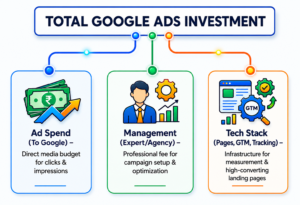
When calculating how much Google Ads cost, many businesses make the mistake of only accounting for the money paid directly to the ad network. A successful marketing ecosystem requires a few extra operational pillars.
1. Agency or Freelancer Management Fees
Unless you have an in-house expert, you will likely need a professional to design, optimize, and monitor your campaigns. Professionals generally charge in two ways:
- Flat Monthly Retainer: Usually ranges between ₹15,000 and ₹50,000 per month for small to mid-sized setups.
- Percentage of Ad Spend: Typically 10% to 20% of your total budget, common for high-spending enterprise clients.
2. Website & Landing Page Design
Sending paid traffic to a cluttered homepage is a fast way to waste money. Investing in dedicated, high-converting landing pages can cost a one-time fee of ₹15,000 to ₹60,000, but it drastically improves your conversion rates.
3. Analytics & Tracking Setup
To measure your Return on Ad Spend (ROAS), configuring tools like Google Analytics 4 (GA4) and Google Tag Manager is non-negotiable. Proper technical conversion tracking setup typically demands a one-time investment of ₹10,000 to ₹25,000.
Strategic Blueprints: 4 Ways to Minimize Your Ad Spend
You do not need an infinite budget to beat industry giants. By deploying smart, hyper-targeted tactics, you can squeeze incredible efficiency out of a modest budget.
- Incorporate Negative Keywords: Tell the system exactly who not to show your ad to. If you sell luxury leather shoes, adding “free,” “cheap,” or “repair” as negative keywords ensures you don’t pay for zero-intent clicks.
- Focus on Long-Tail Keywords: Instead of bidding on highly expensive, broad terms like “shoes,” bid on specific phrases like “waterproof running shoes with arch support.” These terms have much lower competition and significantly higher conversion intent.
- Optimize for Mobile Performance: Over 60% of web traffic originates on mobile devices. Ensure your landing pages load under two seconds on smartphones to preserve your Quality Score and keep users from bouncing.
- Leverage Geographic Bidding: If your data shows that your highest-paying clients live in specific Tier-1 economic hubs, adjust your bidding settings to allocate more capital to those specific regions while reducing spend in non-performing areas.
Maximizing Value From Your Marketing Investments
Ultimately, asking about the flat cost of paid advertising is like asking how much a house costs—it depends entirely on where it is built and how large it needs to be. Because you maintain absolute control over your daily limits and maximum bids, the platform remains one of the most flexible, scalable, and high-yield marketing tools available today.
By relentlessly focusing on your Quality Score, structuring clean keyword groups, and optimizing your website’s conversion funnel, you can easily outmaneuver competitors with triple your budget. To dive deeper into campaign structures and technical definitions, explore the official Google Ads Help Center. If you are completely new to online advertising and want to map out potential traffic patterns for your niche before spending a single rupee, check out the forecasting tools inside the Google Ads Keyword Planner. Brand building is an evolution—start small, track your data obsessively, and scale your spend as your profits grow.