

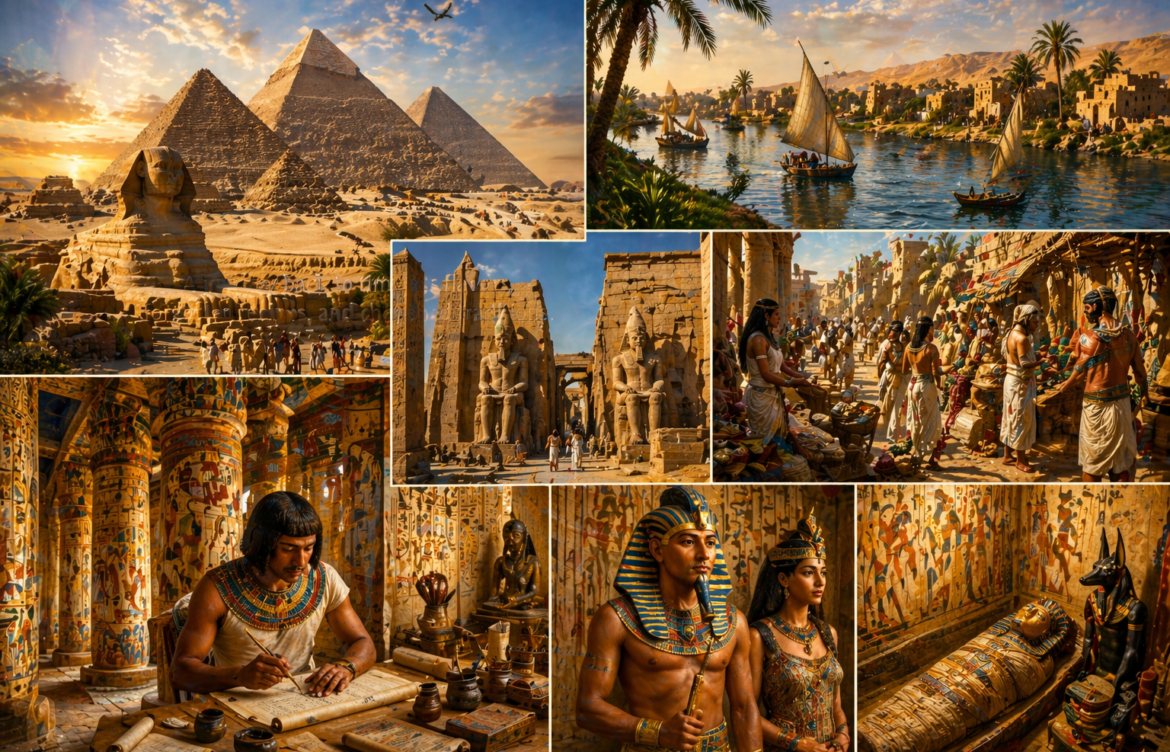
Life and Culture in Ancient Egypt: A Journey Through Time
Ancient Egypt is one of the most fascinating civilizations in human history. Known for its majestic pyramids, powerful pharaohs, and deep spiritual beliefs, it continues to capture our imagination even today. But beyond the grand monuments lies a rich and vibrant culture shaped by everyday life, traditions, and strong connections to nature.
Let’s explore what life was really like in Ancient Egypt—how people lived, worked, believed, and created a civilization that lasted for thousands of years.
The Gift of the Nile
Ancient Egypt would not have existed without the River Nile. Flowing through the desert, the Nile was the lifeline of the civilization. It provided water, fertile soil, and a means of transport.
Every year, the Nile flooded its banks, leaving behind rich black soil perfect for farming. This allowed Egyptians to grow crops like wheat, barley, and flax. Because of this natural cycle, food was abundant, and the society could thrive.
The Nile also served as a highway. Boats carried goods, people, and ideas across cities, helping Egypt stay connected and economically strong.
Daily Life of the People
Life in Ancient Egypt varied depending on social status, but most people were farmers. They worked in the fields during the growing season and helped build monuments during the flooding season when farming paused.
Homes and Living Conditions
Most Egyptians lived in simple houses made of mud bricks. These homes were cool in the hot climate and often had flat roofs where families could relax in the evenings.
Furniture was basic—wooden stools, beds, and small tables. Wealthier families, however, enjoyed larger homes with gardens and decorative items.
Food and Diet
The Egyptian diet was simple but nutritious. Bread and beer were staples, consumed daily by people of all classes. Vegetables like onions, garlic, and lentils were common, while meat and fish were eaten occasionally.
Fruits such as dates and figs were enjoyed as sweet treats. Wealthy Egyptians had access to more variety, including honey and imported foods.
Clothing and Appearance
Due to the hot climate, clothing was light and simple. Men wore linen skirts, while women wore long dresses. Linen, made from flax, was the primary fabric.
Personal hygiene was very important. Egyptians bathed regularly, used perfumes, and even wore makeup—not just for beauty, but also for protection against the sun.
Social Structure and Roles
Ancient Egyptian society was highly organized and followed a clear hierarchy.
- Pharaoh – The ruler and considered a god on Earth
- Nobles and Priests – Managed religious and administrative duties
- Scribes – Educated individuals who could read and write
- Artisans and Craftsmen – Created tools, jewelry, and monuments
- Farmers and Laborers – Formed the majority of the population
Scribes held a special place in society. Literacy was rare, and those who could write were respected and often worked in government roles.
Women in Ancient Egypt had more rights compared to many other ancient civilizations. They could own property, run businesses, and even rule as pharaohs in rare cases.
Religion and Beliefs
Religion was at the heart of Egyptian life. The Egyptians believed in many gods and goddesses, each representing different aspects of life and nature.
They believed that maintaining balance and order—known as Ma’at—was essential for harmony in the world.
Gods and Worship
There were hundreds of gods, but some of the most important included:
- Ra – the sun god
- Osiris – god of the afterlife
- Isis – goddess of magic and motherhood
- Anubis – protector of the dead
Temples were built to honor these gods, and priests performed daily rituals to please them.
Life After Death
One of the most unique aspects of Egyptian culture was their belief in the afterlife. They believed that life continued after death, and preparing for it was very important.
This led to the practice of mummification, where bodies were preserved so the soul could recognize them in the afterlife.
The famous pyramids were built as tombs for pharaohs, filled with treasures, food, and items they would need in the next world.
Art, Architecture, and Innovation
Ancient Egyptians were highly skilled in art and architecture. Their work was not just decorative but also meaningful.
Pyramids and Monuments
The pyramids are among the most iconic structures in the world. Built with incredible precision, they reflect the Egyptians’ advanced knowledge of engineering and mathematics.
Temples, statues, and obelisks were also constructed to honor gods and commemorate rulers.
Art and Symbolism
Egyptian art followed strict rules. Figures were often shown in profile, with heads and legs sideways but eyes facing forward. This style remained consistent for centuries.
Hieroglyphics, a system of writing using symbols, was used to record history, religious texts, and daily life.
Festivals and Entertainment
Life in Ancient Egypt was not all work. Festivals were an important part of their culture and were celebrated with music, dance, and food.
These festivals often honored gods and marked important events like the flooding of the Nile. People wore their best clothes, shared meals, and participated in community celebrations.
Games and sports were also popular. Board games, wrestling, and hunting were common forms of entertainment.
Education and Knowledge
Education was mainly for the elite, especially those training to become scribes. Students learned reading, writing, mathematics, and religious texts.
Egyptians made important contributions to knowledge, including:
- Early forms of medicine and surgery
- A calendar based on the solar year
- Advances in mathematics and geometry
Their understanding of science and nature helped them build a stable and successful civilization.
The Legacy of Ancient Egypt
The influence of Ancient Egypt can still be seen today. From architecture and art to language and science, their contributions have shaped the modern world.
Tourists from around the globe visit Egypt to see the pyramids, temples, and artifacts that tell the story of this incredible civilization.
But beyond the monuments, it is the daily life, beliefs, and traditions of the people that truly define Ancient Egypt.
Conclusion
Life in Ancient Egypt was a unique blend of simplicity and sophistication. While ordinary people lived modest lives, they were part of a highly organized society rich in culture, belief, and innovation.
Their connection to the Nile, respect for the gods, and focus on the afterlife created a civilization unlike any other. Even thousands of years later, Ancient Egypt continues to inspire curiosity and admiration.
Understanding their way of life not only teaches us about the past but also helps us appreciate the roots of human culture and progress.
- No Comments
- April 24, 2026